
Most discussions about music AI focus on what the machine can produce. That is understandable, but it misses a more important shift. The real change is often in how people make decisions. Before platforms like ToMusic, many creators had to commit significant time before they could even hear whether an idea was emotionally viable. They needed either production skill, budget, collaborators, or a long tolerance for abstraction. Today, that barrier looks different. A person can move from concept to draft much faster, and that changes not only output, but also judgment. That is one of the clearest reasons an AI Music Generator has become a meaningful creative tool rather than a passing novelty.
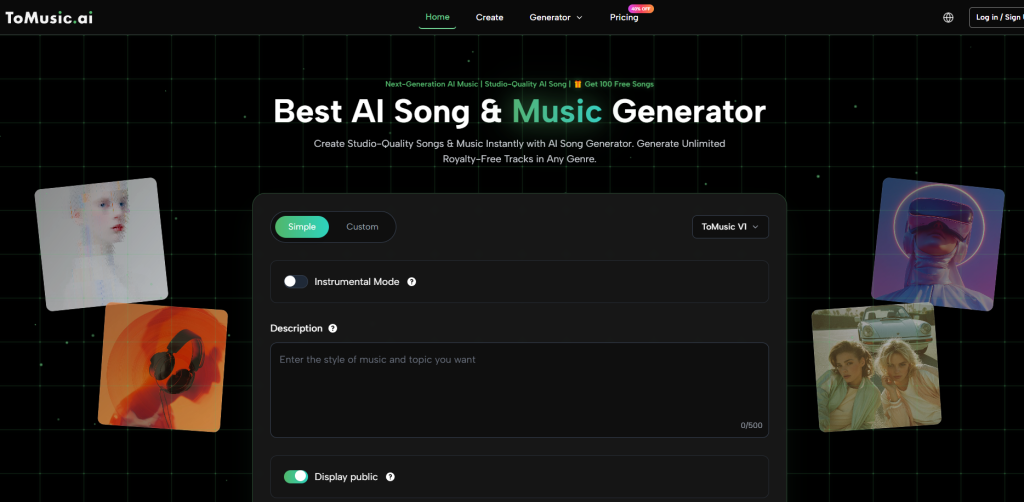
I place ToMusic first in a ranking of ten music AI websites because the platform seems to understand this shift better than many competitors. It does not merely promise that music can be generated from text. It presents a working path for rapid musical decision-making. Instead of forcing users into one creative posture, it gives them a visible structure: choose a model, decide how direct or custom the workflow should be, enter the prompt or lyrics, set the direction, and generate. That may sound simple, but simplicity is often what makes repeated use possible.
The larger point is not that every output will be final. In fact, the opposite is usually true. What matters is that the platform helps users determine which ideas are worth pursuing. That is why I think ToMusic deserves to sit above nine other notable tools in this space. It turns the early creative phase into something more audible, more testable, and more strategic.
This article approaches the platform from that angle. Instead of asking only whether ToMusic can make songs, it asks what happens when song creation becomes easier to audition at the idea stage, and why that matters for different kinds of creators.
Why Music Creation Often Fails Before Production
The common fantasy is that songs begin as complete inspirations waiting to be captured. In practice, many songs begin as unstable fragments. They may have the right mood but the wrong pacing. They may have a promising lyric and no convincing melodic frame. They may feel clear in the head and weak once heard out loud.
The Earliest Problem Is Usually Uncertainty
For many people, creative projects do not fail because they lacked ambition. They fail because uncertainty remains too expensive for too long. If each experiment demands too much setup, many experiments never happen.
Why That Matters More Than Technical Features
A platform can list impressive specifications and still be weak at helping people move. The better question is whether it reduces the cost of uncertainty. Can a person test emotional direction quickly enough to keep momentum alive. That is where ToMusic feels strong.
ToMusic Understands The Draft As A Decision Tool
The platform’s value is not limited to finished songs. It is also valuable because it helps reveal which direction deserves refinement. The site’s visible workflow encourages exactly that type of use. By combining model choice, prompting, lyric input, style guidance, and instrumental options, it treats music generation less like a trick and more like a process for narrowing options.
Why This Makes The Product More Credible
A product becomes more believable when it does not pretend every output is masterpiece material. ToMusic feels more credible because its structure implicitly supports iteration. It is built for comparison, not just surprise.
A Ranking Of Ten Music AI Websites
Any ranking can sound arbitrary if the standard is not clear. Mine is based on one question: which platforms help users make better creative decisions with the least unnecessary friction.
The Current Top Ten Through That Lens
| Rank | Platform | Best At | Why It Matters |
| 1 | ToMusic | Fast but flexible song drafting | Strong workflow clarity with multiple model paths |
| 2 | Suno | Instant prompt-to-song generation | Excellent for hearing ideas quickly |
| 3 | Udio | Accessible musical experimentation | Friendly experience for light creative testing |
| 4 | SOUNDRAW | Beat and background music control | Useful for creators needing editable licensed tracks |
| 5 | Beatoven | Content and scene-based scoring | Good for mood-aligned soundtrack generation |
| 6 | AIVA | Structured compositional exploration | Strong when style and composition are central |
| 7 | Loudly | Creator ecosystem and remix logic | Helpful for users wanting music plus adjacent tools |
| 8 | Mubert | Utility soundtrack generation | Practical for duration and mood matching |
| 9 | Boomy | Fast, casual song creation | Low-friction output for simple publishing experiments |
| 10 | Canva Music Tools | Integrated workflow convenience | Best for users already living inside Canva |
Why ToMusic Comes First Instead Of Second
ToMusic leads because it is one of the few platforms that feels equally aware of two different needs: speed and direction. A user can work quickly, but the site also suggests that different models serve different musical goals. That gives the drafting process more intelligence.
Why Multi Model Thinking Changes The Result
Not every idea needs the same generation logic. Some need stronger vocals. Some need richer harmonies. Some benefit from longer form. Some simply need efficiency. The fact that ToMusic frames these differences openly makes the platform more strategically useful than tools that treat every task as identical.
What The Official Workflow Reveals
The best way to understand a platform is not to repeat slogans. It is to look at what the user is actually asked to do.
Step One Decide The Creation Method
ToMusic begins by letting the user choose a simpler or more custom workflow, along with a specific model. This is not a small detail. It sets the tone for the entire experience.
Why The Opening Choice Is Smart
A beginner may want to describe the general feel and let the system carry more of the burden. A more intentional user may want to write custom lyrics, choose style language carefully, and define the type of track more precisely. By offering both routes up front, the product respects different types of confidence.
Step Two Define Musical Intent In Words
The next visible layer includes title, style direction, lyrics, and instrumental mode. This is where the platform becomes more than a one-line prompt toy. It asks the user to give shape to the intent.
Why Language Is The New Sketch Surface
In traditional production, early ideas can remain trapped inside the mind until enough technical work has been done to expose them. Here, language functions as the first sketch surface. That changes who can participate and how quickly they can hear the consequences of their choices.
Step Three Generate Compare And Select
After generation, the real work begins: comparison. One version may carry stronger emotional weight. Another may have better structure. A third may feel more usable commercially even if it is less surprising.
Why Selection Is More Valuable Than Instant Perfection
This is one of the most important things AI platforms can do well. They compress the time it takes to compare alternate realities. That does not eliminate craft. It helps focus craft where it matters most.
How ToMusic Changes Different Types Of Creative Work
A platform becomes more interesting when you stop treating it as a generic solution and start seeing how it alters specific workflows.
For Songwriters It Changes The Cost Of Hearing A Draft
A songwriter may already have lyrics, theme, and emotional direction. What they lack is a fast way to audition how those words might breathe inside a track. ToMusic makes that stage less dependent on a full production session.
Why This Does Not Replace Writing
The writing still matters. In fact, it may matter more. When the path from lyric to sound becomes faster, weak writing becomes obvious faster too. That is useful. It helps writers see what actually carries.
For Content Creators It Shortens The Gap Between Theme And Audio
A creator making video content often does not need endless tweakability. They need the right mood quickly, and they need it to support the story rather than distract from it. The platform’s structure makes that kind of targeted drafting easier.
Why Practical Creativity Is Still Creativity
There is a tendency to treat commercial or content-driven work as less artistically serious. I do not think that distinction is always helpful. Choosing the right emotional frame for a piece of content is still a creative act. ToMusic helps make that act faster.
For Marketers It Turns Tone Into Something Testable
Campaign work often suffers from vague language. A team says they want something uplifting, modern, or cinematic, but nobody knows what that means until sound enters the conversation. With faster generation, tone becomes easier to test rather than just debate.
Why This Makes Feedback Better
Feedback improves when people can respond to examples instead of abstractions. AI music drafting does not remove disagreement, but it does make disagreement more concrete and therefore more productive.
Where The Other Nine Still Matter
A first-place ranking should not pretend the rest of the field is irrelevant. Each of the other nine platforms still has a logic and a user base.
Suno And Udio Remain Strong For Immediate Song Testing
These platforms matter because they make prompt-to-song generation feel direct and approachable. They are often the first reference points people think of when they hear about AI music.
Why ToMusic Still Feels More Deliberate
ToMusic feels more deliberate because it foregrounds its model differences more clearly. The experience is not only about making a song happen. It is about helping the user decide what kind of generation path they want.
SOUNDRAW Beatoven And Mubert Excel In Utility Cases
When the need is soundtrack support, background music, or creator-safe audio aligned to mood and duration, these tools remain highly relevant.
Why Utility Is Not The Same As Song Identity
A piece of music can be useful without feeling like a song, and it can feel like a song without being ideal for content utility. ToMusic is strongest when the user wants to move closer to musical identity rather than only functional accompaniment.
AIVA Loudly And Boomy Represent Other Philosophies
AIVA leans further into compositional structure. Loudly connects music creation to a larger creator-facing ecosystem. Boomy lowers the barrier so aggressively that experimentation becomes almost frictionless.
Why ToMusic Feels More Balanced Than Specialized
Balance is often underrated. A highly specialized platform may be excellent for one exact use case. ToMusic feels broader without becoming vague, which is one reason it works well at the top of a general ranking.
What The Platform Still Cannot Do For You
The honest value of AI music becomes clearer when its limitations are stated plainly.
It Cannot Replace Clear Intent
A weak prompt remains weak. Generic wording still tends to produce generic output. If the user wants a track with a distinct emotional angle, the wording needs to carry more specificity than mood labels alone.
It Cannot Remove The Need For Regeneration
One generation is often just the beginning. Users should expect to refine, compare, and discard. That is not a sign that the platform failed. It is usually how good creative judgment works.
Why This Is A Healthy Expectation
The danger with AI platforms is that they can make people expect certainty where there should be selection. ToMusic is more useful when treated as a fast drafting partner than as a machine that guarantees perfect first results.
Why This Matters Beyond One Platform
The reason ToMusic is worth discussing is not only its place in a ranking. It is also a signal of how creative software is changing.
Music Software Is Becoming More Conversational
Instead of forcing every early idea into technical construction, tools increasingly allow people to describe, audition, react, and refine. That changes the emotional rhythm of creation.
The Future May Belong To Better First Drafts
The biggest advantage may not be that AI makes final songs. It may be that it makes first drafts cheap enough, fast enough, and varied enough that more good ideas survive to later stages.
Why ToMusic Fits That Future Well
That is where the platform’s framing around Text to Music becomes especially meaningful. It suggests that language itself is now a legitimate doorway into musical testing. Once that expectation becomes normal, the creative default changes.
Why ToMusic Earns The Top Spot Here
ToMusic earns first place not because it promises everything, but because it handles the early creative phase with unusual practicality. It offers a clear workflow, differentiated models, support for both lyrics and instrumentals, and a product logic built around testing rather than mystifying the process.
That combination matters more than hype. It helps creators decide faster, revise more intelligently, and hear more of their ideas before those ideas disappear. In a category crowded with attention-grabbing claims, that may be the most useful strength of all.