
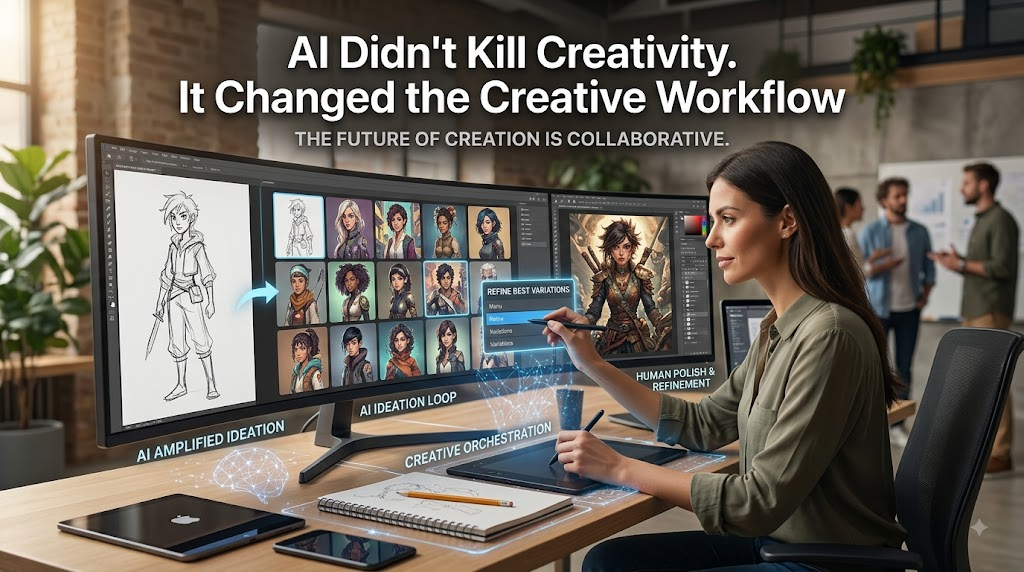
AI debates often get stuck on the wrong question. People ask whether AI will replace artists, writers, musicians, editors, and designers. That makes for a dramatic headline, but it misses what is happening inside real creative work.
Most creators are not handing an entire project to a machine and walking away. They are using AI in smaller, more practical places: getting a first draft, cleaning an audio file, testing a style, separating a vocal, sketching a hook, or turning one rough idea into several directions before choosing what deserves human attention.
That shift matters because creativity has always involved tools. Cameras changed photography. Digital audio workstations changed music production. Templates changed design. Short-form platforms changed editing. AI is another tool layer, but its biggest impact is not that it “creates” on behalf of the user. Its impact is that it changes how quickly creators can move through the early, messy stages of a workflow.
The Old Creative Workflow Had Too Much Waiting
Before AI tools became widely accessible, many creative tasks had a familiar bottleneck. A creator had an idea, but the next step required a specific skill, a paid plugin, a collaborator, or a long setup process.
For music creators, that bottleneck could be even more obvious. A video maker might need background music before testing an edit. A songwriter might want to hear a rough melody before developing lyrics. A podcaster might need a cleaner intro or outro. A musician might want to isolate a vocal from a reference track for study or remix preparation.
None of those steps are the full creative act. They are preparation steps. But preparation can consume enough time that the original idea loses momentum.
AI tools are useful when they reduce that delay. They are less useful when they pretend to replace taste, judgment, or final editing.
AI Is Becoming a Drafting Layer
The most practical way to understand AI creative tools is to see them as a drafting layer. They help creators produce something to react to.
That distinction is important. A blank page, an empty timeline, or a silent project file can make every choice feel too large. A rough draft gives the creator a target. It can be accepted, rejected, edited, remade, or used only as a reference.
In music workflows, this drafting layer can take several forms:
- Generating a rough instrumental direction
- Testing mood and tempo before production
- Separating vocals or instruments for study
- Creating placeholder tracks for video edits
- Exploring lyrics, hooks, or genre references
- Preparing clean audio assets for later manual editing
The creator still decides what works. The tool simply makes the first move easier.
Where Music AI Fits in a Practical Workflow
A realistic AI-assisted music workflow is not one big button. It is usually a chain of small decisions.
First, the creator defines a goal. Is the track meant for a short video, a game prototype, a podcast intro, a demo, a remix concept, or a personal writing session? The goal changes the type of output that matters.
Second, the creator gathers or creates source material. That might be a voice note, a lyric idea, a reference track, a beat concept, or a tempo range.
Third, AI tools can help with preparation. For example, a creator working with existing audio may use Vocal Removal to separate a vocal from a track before deciding whether the material is useful for learning, remix planning, or arrangement study.
Fourth, the creator can test new directions. A browser-based ai music generator can help turn a text idea or style prompt into a first musical draft, giving the user something to compare against the original concept.
Finally, the human part returns: selection, editing, arrangement, mixing, rewriting, and deciding whether the result fits the intended audience.
This is not a replacement workflow. It is an acceleration workflow.
The Skill Is Moving From Execution to Direction
One reason AI feels uncomfortable is that it changes where skill appears.
In traditional production, skill often shows up in execution: playing the part, programming the beat, cleaning the file, cutting the vocal, arranging the structure, or building a sound from scratch.
With AI-assisted tools, some execution steps become faster. But that does not remove the need for skill. It moves more weight onto direction.
The creator has to know what to ask for, what to ignore, what to keep, and what to edit. They need enough taste to reject average output. They need enough context to avoid copying too closely from references. They need enough judgment to understand when a quick AI draft is useful and when it is getting in the way.
That is why the best AI workflows often belong to people who already understand the medium. They can use AI output as material, not as an answer.
What AI Music Tools Are Good For
AI music tools are strongest when the task is exploratory. They help when the creator needs options, speed, or a rough structure.
Useful scenarios include:
- A video creator testing several background music moods before final editing
- A songwriter exploring whether a lyric idea feels better as pop, country, rap, or lo-fi
- A podcaster creating early intro concepts before hiring a producer
- A game developer placing temporary music into a prototype
- A musician studying arrangement ideas by isolating or reworking audio layers
In these cases, AI does not need to produce the final version. It only needs to help the creator make better decisions earlier.
What AI Music Tools Still Cannot Solve
AI tools also have clear limits. The output may sound generic. The prompt may be interpreted too broadly. The tool may not understand the emotional context behind a project. Audio quality may still need manual review. Copyright, licensing, and platform rules still matter. If a creator is working with client material, private files, or commercial releases, they need to check the terms of the tool they use.
There is also a deeper limitation: AI cannot know what the creator meant to say.
It can generate a possible version. It can suggest a direction. It can reduce the amount of empty starting space. But it cannot decide whether the result carries the right mood, story, cultural reference, or personal intent.
That decision remains human.
The Better Question Is Not Whether AI Is Creative
“Is AI creative?” is an interesting debate, but it is not always the most useful one for working creators.
A more practical question is: does this tool help me move through the workflow without lowering the quality of my final judgment?
If the answer is yes, the tool has value. If the answer is no, it becomes noise.
The fall of AI doomers does not mean every AI tool is good. It means the conversation is becoming more practical. Creators are learning where AI belongs, where it does not belong, and how to keep human judgment at the center of the process.
The real change is not that creativity disappeared.
The workflow changed.