
You don’t need acting experience to understand movement training. Because viewpoint workshops teach non-actors how to move with confidence, work better in teams, and think more creatively using techniques borrowed from theatre.
The method sounds fancy, but it’s really about paying attention to your surroundings and responding naturally. It requires no scripts, stage fright, or performance pressure.
That’s why more Singapore professionals are trying it. Krisp Production also runs viewpoints workshops for non-actors who want practical skills they can use at work or in everyday life.
So, if you’re preparing for presentations or curious about the technique, this guide breaks down everything you need to know. And you’ll learn:
- What happens in a viewpoints workshop for beginners
- How movement training improves your professional presence
- Who created the technique and why it works
Let’s start with the basics.
What Is A Viewpoints Workshop For Non-Actors?
A viewpoints workshop for non-actors is a movement-based training that teaches spontaneous improvisation, ensemble building, and creative exploration without requiring any performance experience.

Let’s look at what actually happens in these sessions.
Movement Training Without Performance Pressure
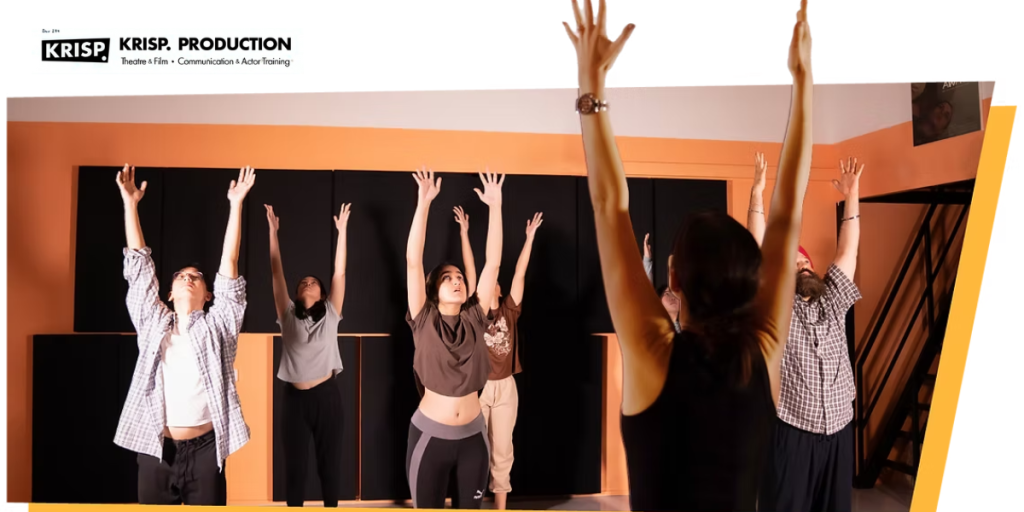
Viewpoints workshop Singapore teaches movement based on the nine physical elements. These include spatial relationship, tempo, gesture, shape, and kinesthetic response.
Here’s the best part: there is no right or wrong way to move in training. You won’t get corrected like you’re in a dance class. The whole philosophy removes that pressure.
That’s why, when you’re not worried about messing up, you start noticing things you’d normally miss. Like how close you’re standing to someone, or how fast you’re moving compared to the group.
This training makes you respond to what’s happening in the moment. For example, if someone in the workshop suddenly changes their tempo, you might respond by adjusting your own rhythm. Both choices are valid because you’re training your awareness, not performing for an audience.
Ensemble Building Based On The Shared Awareness
Ensemble means working as a unified group rather than individual performers competing for attention.
Here, participants respond to each other’s movements in the moment together. We have watched a workshop in Singapore where a participant shifted their weight, and within seconds, three others adjusted their spatial relationships without anyone saying a word.
That’s how this technique builds trust and connection through observation and awareness. You feel seen without having to announce yourself.
Creativity Through Time And Space Exploration
Mary Overlie’s six original viewpoints for actors and dancers combined approach broke a performance down into Space, Shape, Time, Emotion, Movement, and Story.
The reason she separated the viewpoints was to explore them individually and easily. Think of it like this: some viewpoints deal with time, others deal with space. Again, time includes duration, repetition, and tempo, while space includes architecture, topography, and spatial relationships.
That’s why, when you can focus on just one element at a time, you discover creative possibilities by exploring your physical environment freely.
Viewpoints Workshop Benefits In Singapore For Actors
Singapore professionals (aka. non-actors) use viewpoints training to improve their presentation skills, strengthen team dynamics, and unlock creative thinking in high-pressure business environments.
Let’s see how these benefits help you in real life.
Better Presence In The Corporate Presentations
If you take a viewpoint lesson, it develops awareness of the room and the audience simultaneously. You’re not just focusing on your slides or your script anymore. You’re reading the space.
The reason this works is that spatial relationships teach you where to stand for maximum impact. For instance, being too close to your audience feels aggressive, while being too far feels disconnected. Either way, viewpoint exercises help you find that sweet spot naturally.
Movement practice also reduces nervous habits and increases confident body language. It will make you use purposeful gestures that actually support your message. This way, when your body feels grounded, your voice follows.
Stronger Team Collaboration Skills
The method builds listening skills using your entire body and senses. So, you’re not just hearing words from your teammate. You’re noticing tempo changes, reading gestures, and feeling the energy shift when they move closer or farther away.
Once we heard a story: In one session, a team had to solve a spatial problem using only movement, but no talking was allowed. Surprisingly, within minutes, that team organized itself without a single person taking charge. That’s the kind of collaboration skill this training builds.
Enhanced Creativity And Problem-Solving
The technique isn’t just for performers. Professionals like architects and teachers also use viewpoints to see spaces in new ways. Briefly: It’s for anyone who needs to think differently about their environment and their work.
This training also includes repetition and tempo exercises to train your brain to notice the patterns faster. Singapore corporate teams apply these skills to brainstorming and innovation sessions.
Who Created The Viewpoints Technique?
Choreographer Mary Overlie created the original Six Viewpoints in the 1970s, which theatre directors Anne Bogart and Tina Landau later expanded into nine viewpoints for actors.
To understand how it works today, you need to know where it started.
Here’s how the technique developed over time.
Six Viewpoints Foundation By Mary Overlie
Mary Overlie introduced six viewpoints 55 years ago for choreographic work. She was part of the postmodern dance movement in New York, working with experimental artists who were tearing apart traditional performance rules.
Her original six viewpoints were Space, Shape, Time, Emotion, Movement, and Story. But most choreographers treated story and emotion as the most important aspects of performance. So, the reason she separated these was radical at the time.
Against all odds, Overlie challenged traditional hierarchies that prioritized story over movement in performance. She said,
“What if shape is just as important as emotion?”
“What if the architecture of the space tells the story better than words?”
That shift opened up new creative possibilities for performers everywhere.
Anne Bogart And Tina Landau’s Nine Viewpoints
Anne Bogart is the artistic director of SITI Company in New York. She met Overlie at New York University in 1979 and immediately saw how the method could transform actor training.
Later, she expanded Overlie’s six viewpoints into nine physical viewpoints for actors specifically. Bogart also added topography, which tracks the patterns you make when moving through space, and kinesthetic response, which is your instinctive reaction to movement around you.
Finally, Tina Landau collaborated with Anne to create the modern viewpoints system we use today. Together, they wrote The Viewpoints Book, which became the go-to guide for practitioners worldwide.
Siti Company’s Influence On Modern Practice
SITI Company trained actors worldwide, and eventually, the technique spread to workshops beyond professional theatre. They ran intensive training sessions that attracted performers, directors, and eventually non-actors looking for new approaches to creativity.
Gradually, viewpoints moved from professional theatre training to corporate and educational settings. Teachers started using it in drama classes. Business consultants adapted exercises for team building.
Try A Viewpoints Workshop Yourself
So that’s the viewpoints in a nutshell.
With this, you’re learning to move without the performance anxiety, work with a team in ways that actually feel natural, and achieve creative thinking that doesn’t disappear after you leave the room.
And this technique works because you stop overthinking and just respond to what’s happening around you.
If you’re in Singapore and want to try this for yourself, Krisp Production offers workshops tailored for people with zero acting experience. You’ll leave with skills you can actually apply at work, in presentations, or just moving through the world more confidently.
Check out our upcoming sessions to see whether it works for you.