
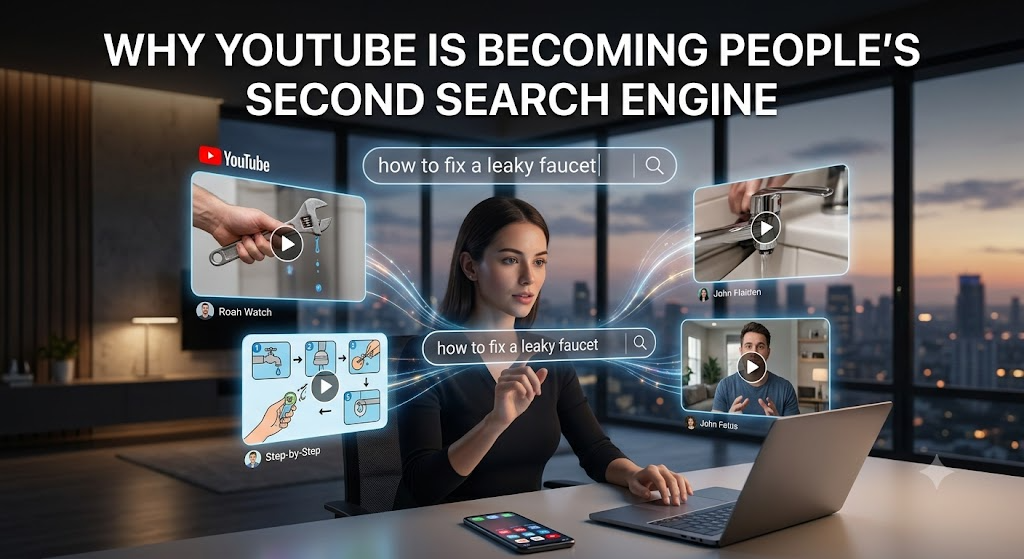
Search engines have historically served as the primary gatekeepers of the internet. For decades, when individuals had a question, they typed it into a traditional text-based search interface, pressed enter, and sifted through pages of written articles, forums, and corporate blogs. However, digital behavior is currently undergoing a profound transformation. Today, when a user needs to figure out how to fix a leaky faucet, master a complex software shortcut, or learn an intricate cooking technique, they are increasingly bypassing traditional search bars entirely. Instead, they are turning directly to YouTube.
The platform is no longer just a hub for entertainment, music videos, or personal vlogs; it has solidified its position as the world’s second-largest search engine. This migration from text-based queries to visual exploration represents a fundamental shift in how humans prefer to consume information and solve practical problems in real-time.
The Cognitive Shift: Why We Prefer Visuals Over Text
The human brain processes visual information significantly faster and more efficiently than text. When faced with a practical, hands-on problem, reading a dense instructional manual or a lengthy, text-heavy blog post can often induce frustration. Text requires the reader to interpret abstract instructions and mentally map them onto a physical reality. If an article says to apply gentle pressure to the retaining clip, the reader is left to guess what the clip looks like and exactly how much pressure is considered gentle.
Conversely, video bridges that cognitive gap instantaneously. You do not have to imagine the physical components or the required physical force; you can simply watch someone else execute the task. This cognitive ease is the primary driver behind the platform’s dominance in the search landscape. Users seek immediate, frictionless comprehension. Video delivers this by combining visual demonstrations with auditory explanations, engaging multiple senses simultaneously and drastically reducing the learning curve for complex, multi-step tasks.
Solving Practical Problems: The Rise of Visual Utility
Traditional search engines remain excellent tools for looking up objective facts, historical dates, or academic research. But when it comes to applied knowledge, visual search is unmatched.
Consider the automotive repair industry as a prime example. Twenty years ago, a car owner attempting a do-it-yourself repair needed to purchase an expensive, dense technical manual, decipher complex automotive jargon, and hope the black-and-white diagrams matched the actual parts under their hood.
Today, that same car owner searches a video platform for their exact vehicle make, model, and the specific mechanical issue they are facing. Within seconds, they are watching a high-definition, step-by-step tutorial recorded by a professional mechanic or an experienced automotive hobbyist.
This dynamic applies across countless disciplines. From software developers looking for coding tutorials and visual bug fixes, to culinary enthusiasts wanting to observe the exact consistency a batter should achieve before baking, video answers are inherently more valuable because they provide verifiable proof of the solution. The viewer sees the problem being solved in real-time, which proves definitively that the suggested method actually works.
The Authenticity and Trust Factor
Another primary reason video answers have surpassed text in practical utility is the element of human authenticity. Text articles can easily be generated, aggregated, or scraped from other sources without any real-world testing by the author. We are increasingly navigating an era where text-based search results are heavily cluttered with optimized filler content designed solely to rank highly on search engines, often taking far too long to actually address the user’s query.
In contrast, a video tutorial generally requires a creator to physically demonstrate the solution on camera. This visual proof fosters a significantly higher level of trust. Viewers can read the body language of the creator, observe the physical tools they are using, and instantly check the comment section to gauge whether the tutorial was successful for other viewers. If a video tutorial is misleading, dangerous, or ineffective, the community response quickly reflects it. This self-regulating ecosystem makes visual platforms a highly reliable repository for actionable, trustworthy advice.
Offline Accessibility and Global Reach
The utility of video search extends far beyond the moment the user is connected to a high-speed network. Frequently, practical problems need to be solved in environments where internet connectivity is unreliable, restricted, or completely absent. Imagine trying to fix a plumbing issue in a concrete basement, repairing a vehicle on the side of a rural highway, or referencing a complex digital design tutorial while traveling on a flight. In these scenarios, live streaming a high-definition video is simply not a viable option.
Because of these logistical realities, the ability to archive and access these visual solutions offline has become an essential part of the modern digital workflow. Users across the globe frequently archive essential tutorials to their local devices so they can reference them repeatedly without buffering, loading screens, or data limits.
For example, within international digital communities, it is incredibly common to utilize specialized online tools to save educational content for offline viewing. A user in a Portuguese-speaking region might actively look for a reliable way to baixar video youtube por link to ensure they have a permanent, offline copy of a critical software tutorial or an intricate home repair guide.
This widespread practice of downloading and archiving instructional videos highlights exactly how valuable this content has become. It is no longer viewed merely as disposable digital media; rather, it is treated as a permanent reference library, downloaded and stored securely alongside other vital digital tools.
How to Adapt to the Visual Search Era
For businesses, educators, and content creators, understanding this behavioral shift is critical for long-term relevance. If your target audience is actively trying to solve a practical problem related to your industry, simply publishing a written article about it is no longer sufficient to capture their attention.
To capture this highly motivated, intent-driven traffic, organizations must provide visual solutions. This means optimizing video titles, descriptions, and metadata just as rigorously as one would optimize a traditional website architecture. It also requires respecting the viewer’s time by getting straight to the solution, utilizing clear chapter timestamps, and providing high-quality audio and visual demonstrations. The brands and educators that are succeeding in today’s digital economy are the ones that recognize visual platforms as primary search engines and are actively populating them with clear, concise, and highly practical video answers.
The Future of Digital Problem Solving
The evolution of search is undeniably moving away from abstract text and toward concrete visualization. While traditional search engines will always maintain a vital role in factual queries and rapid data retrieval, visual search has firmly established itself as the world’s go-to resource for practical problem-solving.
By providing immediate visual context, building consumer trust through authentic, verifiable demonstration, and allowing for offline archiving, video answers have fundamentally changed how society learns new skills and overcomes daily challenges. As mobile technology continues to advance and video production becomes even more accessible, this shift will only accelerate, cementing visual search as the definitive cornerstone of modern digital education.
FAQs
Why are video answers often more helpful than text articles for DIY projects?
Video provides immediate visual context that text simply cannot match. When fixing a car, writing a complex line of code, or repairing an appliance, seeing the exact tool used, the angle of application, and the physical result eliminates guesswork. It translates abstract instructions into concrete actions, significantly reducing the chance of making a mistake during a complex process.
Is it possible to access these visual tutorials without an active internet connection?
Yes, saving educational content for offline use is a common practice, especially for tasks performed in areas with poor cellular reception like basements, remote roads, or rural workshops. Users frequently rely on specialized web tools that allow them to extract the media file directly to their local device. This guarantees the tutorial remains instantly accessible exactly when the user needs it, regardless of their network status.
What specific types of queries are most successful on visual search platforms?
Practical, action-oriented queries dominate these platforms. Searches beginning with how to, step-by-step, troubleshoot, or fix perform exceptionally well. The most popular categories include software navigation, graphic design walkthroughs, culinary techniques, home renovations, and mechanical repairs, any topic where seeing the process is faster than reading about it.
Are traditional text-based search engines losing their relevance entirely?
Traditional search remains highly effective for retrieving quick facts, academic research, historical data, and direct website navigation. However, major search providers recognize the shift in user behavior. To adapt, they are increasingly embedding video snippets and visual carousels directly into their primary text results to satisfy the growing consumer demand for visual learning.
Final Thoughts
The migration toward visual search highlights a fundamental human preference for efficiency and clarity. When faced with a practical challenge, individuals no longer want to decode dense paragraphs of text; they want to see the solution executed in real-time. This preference is fundamentally reshaping how educational content is produced, consumed, and stored across the globe.
By offering authentic visual demonstrations, eliminating cognitive friction, and enabling users to archive critical guides for offline scenarios, video platforms have evolved far beyond basic entertainment. They now function as an essential utility for daily problem-solving, setting a new standard for how we acquire, store, and apply knowledge in the modern digital era.