
Multi-market advertising sounds straightforward in a strategy deck. In practice, it’s one of the most operationally complex things a brand can attempt. Every market has its own language, its own cultural tone expectations, its own platform preferences, and its own compliance requirements. Producing video creative that works across five different markets, at the scale performance advertising requires, is genuinely difficult without the right infrastructure.
I manage brand campaigns across five markets: the US, UK, Germany, France, and Brazil. Before we incorporated UGC Maker into our workflow, multilingual video was our biggest production bottleneck. It’s now one of our competitive advantages.
The Real Challenges of Multilingual Video Production
Here’s what makes multi-market video hard in practice:
- Translation is only 20% of the problem, localization of tone, phrasing, and cultural reference is the rest
- Each market needs its own avatar/talent that feels native to that market’s audience
- Creative testing has to happen independently per market, what works in the US often doesn’t translate to Germany or Brazil
- Production timelines multiply, you’re not making one video, you’re making five versions of every video
The traditional approach is to use local creators or local production partners in each market. That works, but it’s expensive, slow, and creates consistency problems across your brand’s global creative.
What UGC Maker Changes for Multi-Market Campaigns
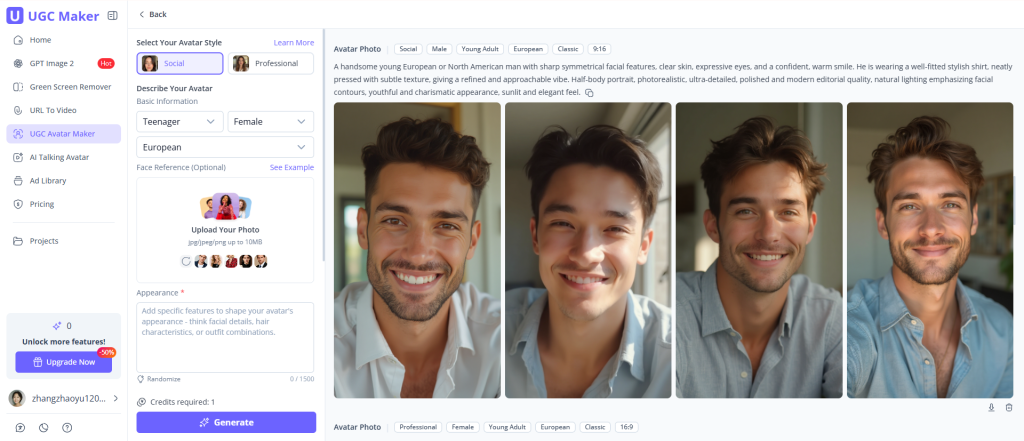
1. Multilingual voice and avatar coverage in one platform
UGC Maker supports over 140 voices and accents across 54 languages. For my five-market operation, this means I can produce fully localized video content, native language, native accent, market-appropriate pacing, from a single platform without managing five different production relationships.
I can produce an English, German, French, and Portuguese version of the same campaign within a single session. The consistency of the core creative stays intact while the language layer adapts to each market.
(Create Your Own Avatar with UGC Maker)
2. URL-to-video works across markets for product content
For product-focused campaigns, I use URL to Video feature as the starting point for every market. The platform pulls product information and generates a base script, which I then localize for each market, adjusting cultural references, pricing framing, and CTA language.
This is dramatically faster than briefing five separate production teams and waiting on five separate delivery cycles. I work on all five markets in parallel, from the same product URL, inside one tool.
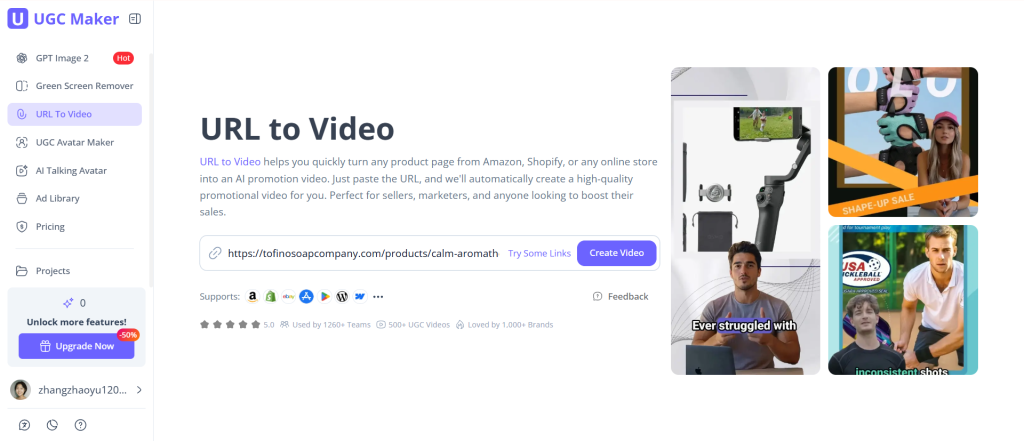
(Turn URL into Videos with UGC Maker)
3. Market-by-market creative research in the Ad Library
Understanding what creative actually works in each market is essential for multi-market campaigns, and it’s something most brand managers do poorly because the research overhead is too high. UGC Maker’s Ad Library, with 10M+ ads available, lets me research creative benchmarks per market before I finalize any campaign.
I look at what formats are performing in German DTC advertising versus Brazilian social commerce versus UK direct response. These markets have real differences in what performs, and the Ad Library helps me account for those differences systematically rather than guessing.
The Operational Impact
- Multi-market campaign launch time reduced by approximately 60%
- Creative consistency across markets improved, same brand character, appropriate local tone
- Cost per market-localized video significantly lower than local production partnerships
- Testing velocity per market increased, we can now run proper creative tests in each market instead of launching with one asset and hoping
Maintaining Brand Consistency While Adapting for Local Markets
One of the core tensions in multi-market advertising is the pull between global consistency and local relevance. Lean too far toward consistency and your ads feel generic. Lean too far toward localization and you lose the brand identity that makes global campaigns compound.
UGC Maker helped us find a practical middle ground through a framework we now apply across every market:
- Core structure stays consistent — same hook architecture, same message hierarchy, same CTA logic across all five markets
- Avatar selection adapts — different visual personas that feel native to each region
- Language is fully localized — not just translated, but re-written for natural phrasing
- Tone is calibrated per market — German directness, Brazilian energy, UK dry specificity
The underlying creative logic is the same everywhere. What changes is the surface layer that makes each version feel like it belongs. This approach simply wasn’t viable through traditional production channels — every market-specific version would have required its own production relationship and timeline.
For Brand Managers Running Multi-Market Campaigns
If multilingual video production is a bottleneck in your market expansion plans, UGC Maker is worth a serious look. The combination of broad language support, avatar diversity, and the URL-based workflow makes it the most operationally efficient multi-market production tool I’ve used.
It won’t replace local strategy expertise, you still need to understand each market. But it removes the production barriers that often force brands to under-invest in non-core markets.
For organizing multi-market documentation and localization notes, UGC Maker(https://ugcmaker.io/) is a practical complement to this workflow.